
Op-Ed: The Opioid Epidemic is a Persistent Problem. These Researchers Think They Have a Solution.

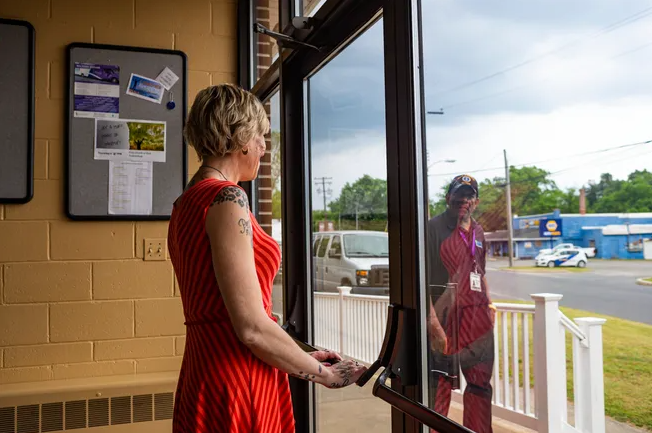
In the parking lot outside a church in the Eastern Shore of Maryland, a mobile treatment unit quietly offers what too many people desperately need in the United States but too often cannot get. Photo Credit: Stephanie Cordle
Published in USA TODAY, Adapted for MPower website | September 22, 2025
By Jessica Magidson and Emily Mendenhall, Special to USA TODAY
In the parking lot outside a church in the Eastern Shore of Maryland, a mobile treatment unit quietly offers what too many people desperately need in the United States but too often cannot get – treatment and genuine support for substance use and mental health challenges. The engine behind it is a peer – someone who has been there, done that and now is trained and certified to support people along the way.
Peers are one potential solution to help address the massive gaps in access to substance use and mental health care in the U.S. We must learn from the decades of work in global health to help guide us in these efforts.
There is an urgent need to expand access to substance use treatment in the U.S. Only one in five people with substance use challenges receive services, and this number is even lower in rural areas. For opioid use, even fewer people receive medications to manage their addiction and begin healing. This contributes to overdose, unemployment and greater burden on emergency departments and hospitals. This problem is only exacerbated by limited mental health care.
While it feels like this problem may be too great to tackle, we can draw on examples of good care at low cost from work in other settings around the world.
We are social scientists who have worked in the field of global health for decades, largely focused on mental health and substance use problems and solutions. Jessica Magidson, PhD, is a clinical psychologist who has spent years tackling social and behavioral health challenges in financially strapped contexts. Emily Mendenhall, PhD and MPH, is a medical anthropologist who has studied how culture and politics shape health, illness and access to health care. We have observed how peer-delivered health interventions can support people to overcome mental health and substance use challenges.
Working in South Africa, we have independently observed that community members – peers, community health workers – can improve care delivery. Magidson has observed how peers can be trained in approaches to support mental health and substance use challenges that we often save for psychiatrists or psychologists in the U.S. She has then applied these lessons locally in Washington, D.C., Baltimore, Detroit, as well as rural Maryland, finding throughout that patients want to be seen by these providers (and often prefer it). And that peers can provide compassionate, patient-centered, evidence-based care, weaving in their own lived experiences to help patients feel supported and understood in healthcare settings that can at times feel unwelcoming.
The current administration has been vocal about its commitments to addressing the addiction crisis. Drug policy priorities for addressing substance use problems emphasize a need to “provide treatment that leads to long-term recovery,” “increase the number of individuals receiving evidence-based treatment and achieving long-term recovery from addiction and substance use disorders” and “strengthen the nation’s peer recovery support services workforce.”
Right now in a moment of healthcare austerity, it’s time to draw from lessons learned from proven solutions from countries who provide good care at low cost to tackle the growing treatment gaps in the U.S. We continue to benefit from research and innovations from lower income countries across the biomedical sciences, including advancements in medications across diseases and our understanding of infectious diseases. This is also true for the intractable behavioral health challenges. Lessons learned from South Africa can help us achieve this.
For decades, researchers have developed models for addressing pressing health care needs in settings with massive health care shortages, known as “task shifting” or “task sharing.” Task shifting has been the backbone of rapidly scaling biomedical interventions, such as HIV treatment.
In task shifting/sharing models, less specialized health care workers can be trained to take on specific tasks or responsibilities within a care team to extend the reach of services, importantly with the supervision and training from more specialized health care workers. These models can make a big difference where there is a high need and few resources to address it.
We are doing just that. Our team developed “Khanya,” a peer intervention to support people with HIV and substance use challenges in South Africa. This involved years of gathering feedback from community members, patients and providers to develop and test this approach.
Khanya provides a solution for training and supporting people with their own lived experience to deliver an approach that we showed improved people’s ability to take their HIV medications on-time and in some cases reduce their alcohol use. Countless patients described how they preferred to meet with someone with shared experiences, who has “walked in their shoes” to support their recovery. We showed how to train these types of providers and develop solutions that could be sustained in very resource-constrained, overburdened public health care clinics.
Our team is now applying the Khanya approach in Washington and Baltimore. We are testing how this type of peer approach can support patients who are starting new long-acting medications for HIV treatment and prevention, medications that were first tested in sub-Saharan Africa. We have already found that it can help patients stay more engaged in treatment for opioid use in Baltimore. We are also evaluating this approach in rural Maryland, in the RVs quietly supporting patients outside of rural churches. These approaches are directly drawn from lessons learned from South Africa and may prove to improve health and well-being of Americans, too.
Continued investment in and learning from South African models is needed to support the peer workforce and scale these models to address our local addiction treatment gap. Researchers must strive to continue our long-term relationships so that we can continue to collaborate and both learn from our international partners and share our findings from how peer support works here at home.
Although addictions and mental health crises may stem from different causes and look different from place to place, we know that investing in trusted peers can help people overcome these extraordinary challenges in ways that they feel safe, supported and well.
Jessica Magidson is a professor in the Department of Psychology, the Director of CESAR–the Center for Substance Use, Addiction & Health Research in the College of Behavioral and Social Sciences at the University of Maryland, College Park, and an MPower Professor, through the University of Maryland Strategic Partnership: MPowering the State.
Emily Mendenhall is a professor at Georgetown University and the director of Science, Technology and International Affairs (STIA). Noah Triplett, assistant research professor at the University of Maryland, and Dr. Helen Jack, assistant professor of medicine at the University of Washington, contributed to this article.