
The Future of Health Care
Adapted from the Engineering at Maryland magazine | Published January 13, 2026
The University of Maryland, College Park (UMCP) and the University of Maryland School of Medicine at the University of Maryland, Baltimore (UMB) have launched a B.S.- M.D. program to prepare highly motivated undergraduate students majoring in engineering, computer science, or mathematics to succeed in medical school.
Students enrolled in the B.S.-M.D. program will complete their undergraduate degrees while gaining hands-on clinical experience at the School of Medicine. They will also be paired with a faculty member for a one-year research project related to engineering or data science with a clear health care impact and receive advising on pre-med coursework requirements. Designed to help students see the connections between data, innovation, and patient care, the program will encourage them to think critically about how bias and health disparities impact medical outcomes, especially as technologies such as artificial intelligence become more pervasive in health care.
The B.S.-M.D. program aims to recruit more engineers and data scientists into clinical professions, helping to bring new skills and perspectives into the future of medicine. It is supported by a five-year, $12.75 million grant from the University of Maryland Strategic Partnership: MPowering the State, which connects the world-class strengths in education, research, and technology at UMCP and UMB.
Biomedical Advances for Glaucoma
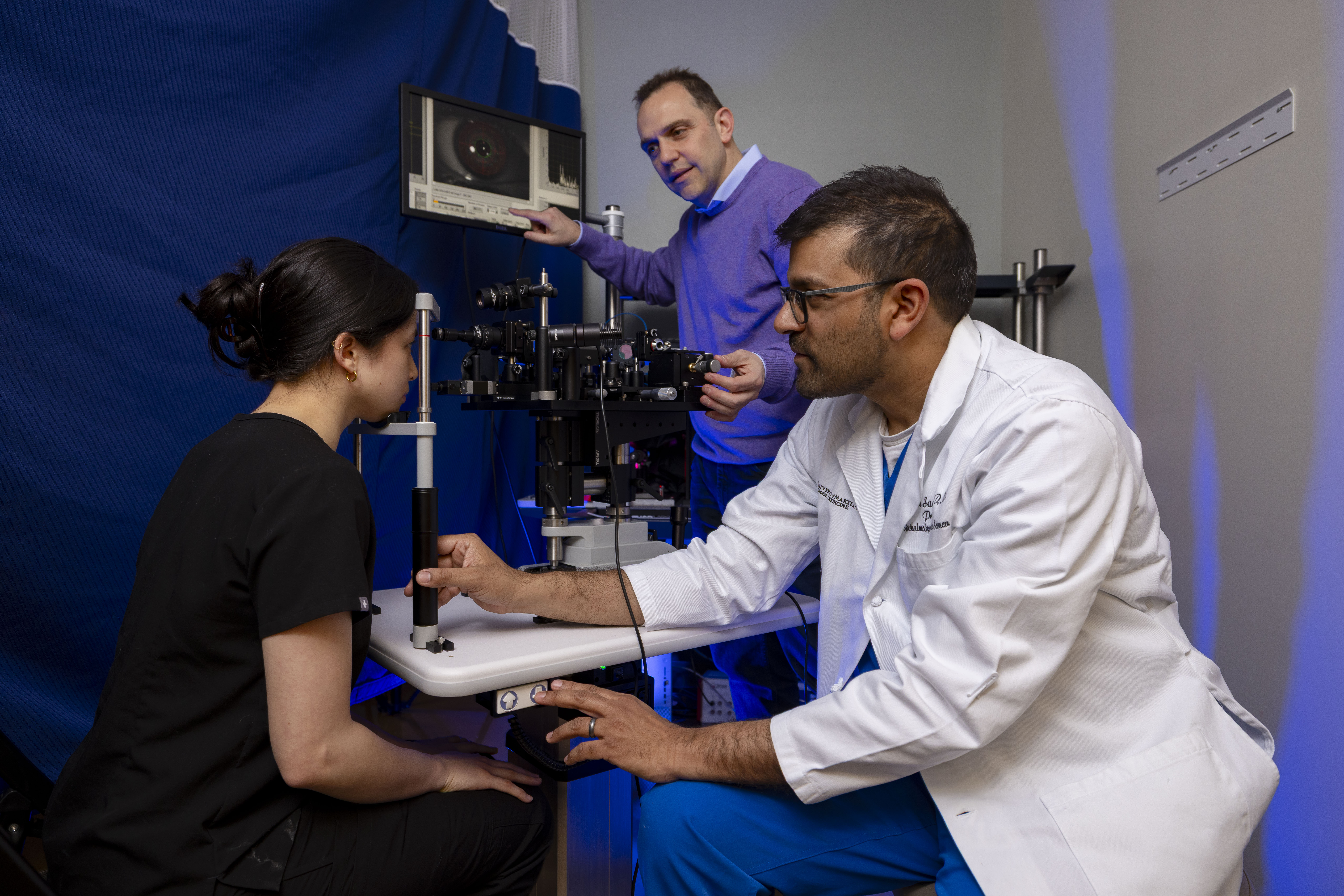
Giuliano Scarcelli — a UMCP professor of bioengineering and co-director of the Edward & Jennifer St. John Center for Translational Engineering and Medicine — has spent his 20-year career building novel microscopes that detect early stages of corneal disease. Now he is using his technology to explore the causes of glaucoma: a progressive, irreversible disease that is the second-leading cause of blindness worldwide.
Debuting earlier this year for patient testing at the School of Medicine, a first-of-its-kind microscope built by Scarcelli relies on Brillouin microscopy, a light-scattering technique that measures the stiffness of tissues and cells.
Dr. Osamah J. Saeedi — an expert in glaucoma and professor of ophthalmology and visual sciences at the School of Medicine who joins Scarcelli as co-director of the St. John Center—is betting that the new microscope can success- fully be applied to his patients: “For glaucoma, there’s been a real need to determine the basic biomechanics of the eye. We want to find a way to do it noninvasively, and with Giuliano’s technique there is vast potential.”